
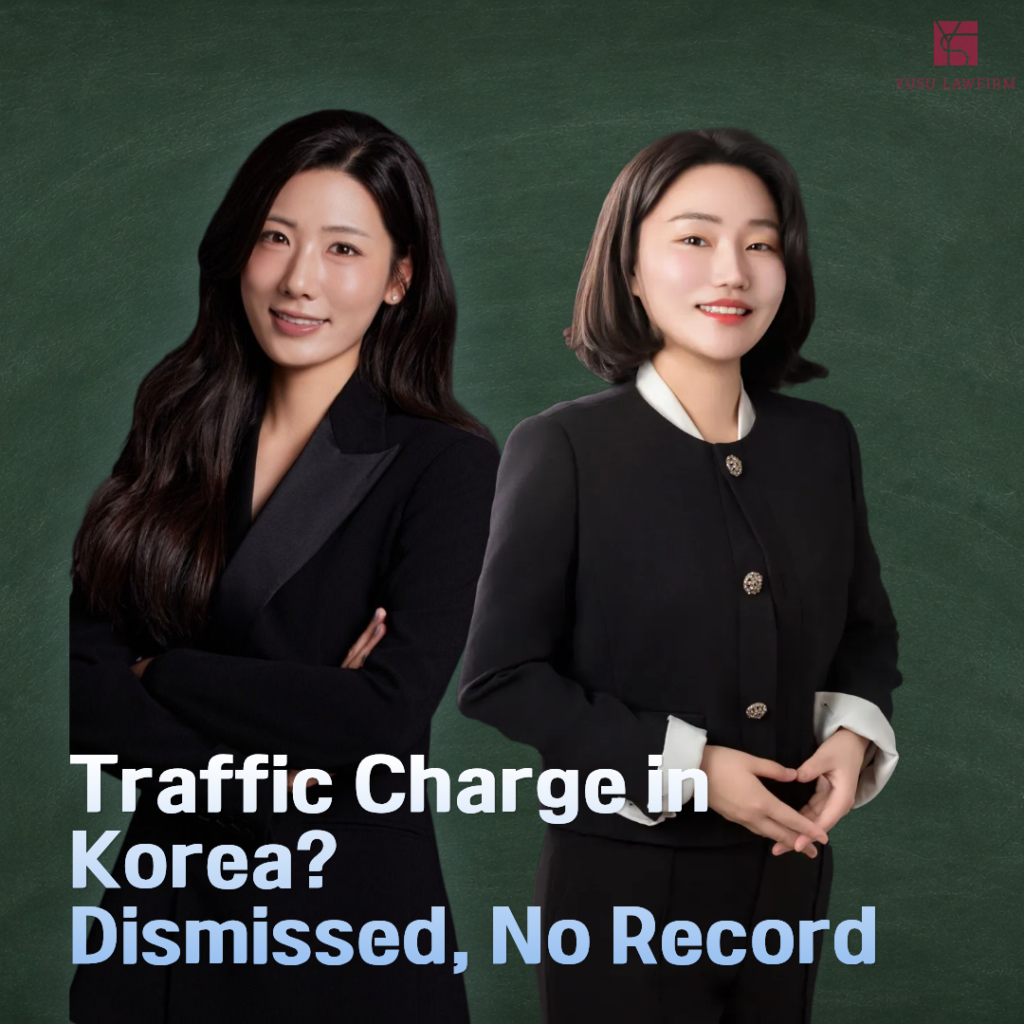
Written by Attorney Soobin You, a former prosecutor licensed in Korea, defending criminal cases with consultations available in English.
Quick answer: In Korea, some traffic cases can be defeated not by disputing the facts, but by challenging whether the prosecution itself was lawful. When a charge rests on stretching the law beyond its text, a court can issue a dismissal of prosecution (공소기각), which, unlike an acquittal, means no criminal record follows. In one case, that is exactly what happened.
For foreigners in Korea, a traffic charge can feel like a fight only over what happened at the scene. But sometimes the stronger battle is over the law itself. Here is how one case was won on the legality of the prosecution, from a Korean English-speaking lawyer’s perspective.
Background and the meaning of a dismissal
The client was charged in connection with a traffic accident. From the earliest stage, we assessed that the charge rested on an expansive interpretation that conflicted with the principle of legality in criminal law (죄형법정주의), the rule that a person may only be punished on a clear legal basis. Applying the law to a defendant’s disadvantage through an interpretation that departs from its text and structure is not permitted under the principles of criminal law.

The procedure and the legal argument
Soon after being retained, we submitted written opinions on three or more occasions in a systematic way, pointing out the unlawfulness of the prosecution point by point, grounded in relevant Supreme Court precedent and leading legal commentary. By structuring the issues so the court would examine in depth the legal premises on which the prosecution depended, we led the court to a dismissal of prosecution.
This is different from an acquittal. It is a finding that the prosecution was not lawful in the first place, and the effect is that no criminal record remains for the client.
The heart of this case was not organizing the facts, but a battle over the law itself, over whether prosecution was even possible. Drawing on experience with how charges are built and maintained, we identified the weak points in the structure of the charge and the gaps in its logic, and focused our attack on the structural problems with the prosecution to reach a dismissal.
What actually matters in a traffic case
Traffic cases are often mistaken for disputes over facts alone. In court, however, they can involve complex legal issues, including the interpretation of traffic regulations, the intersection of administrative and criminal law, and the principle of legality and the prohibition on analogical interpretation. The role of the defense extends beyond simply asking to “lower the fine,” reaching all the way to examining and challenging, from the ground up, whether the legal requirements for the offense are even met.

The practical effect of a dismissal
The greatest significance of a dismissal of prosecution is that it leaves no criminal record. Even an acquittal is followed socially by the fact that a person “was prosecuted,” but a dismissal confirms that the process itself was unlawful, which carries a stronger restorative effect for one’s reputation. In this case too, the client was freed from the anxiety and risk of disadvantage that prosecution brings, and was able to make a fresh start.
Persuasion built on a clear structure
We did not simply list statutory provisions. We explained, from the court’s perspective, why the argument should be accepted, presenting the arrangement of the issues, the layering of the points, and the soundness of applying the precedents in a clear narrative structure. As this preparation accumulated, the logic for maintaining the prosecution lost its persuasive force, and a dismissal of prosecution was the final result.
A traffic case does not have to stop at reducing a sentence. Depending on the circumstances, challenging the very legality of the prosecution can block a criminal record at its source. If you face a criminal process arising from a traffic accident, setting the right strategy from the start decides the outcome.

For how we handle this type of matter, see DUI & Traffic Defense. More outcomes are collected in our Case Results.
Frequently Asked Questions
Q: What is a dismissal of prosecution (공소기각) in Korea?
A: It is a court decision that the prosecution itself was not lawful. It differs from an acquittal, which decides the merits. A dismissal means the case ends without a valid prosecution, and no criminal record results.
Q: How is a dismissal different from an acquittal?
A: An acquittal finds the person not guilty on the merits, but the fact of having been prosecuted remains. A dismissal confirms the process was unlawful from the start, which can carry a stronger effect for restoring one’s reputation.
Q: Can a traffic case really be won without disputing the facts?
A: Yes, in some cases. Traffic matters can turn on legal issues such as the interpretation of regulations, the line between administrative and criminal law, and the principle of legality. Challenging whether prosecution was even lawful is one such path.
Q: Why does the early stage matter in these cases?
A: Because identifying a structural or legal defect in the charge early, and building the argument around it, is what makes a dismissal possible. Setting the strategy from the start is decisive.
Q: I’m a foreigner facing a traffic charge in Korea. Can I get help in English?
A: Yes. A Korean English-speaking lawyer can take your account in English and analyze not only the facts but the legality of the charge itself, which can open outcomes beyond a simple sentence reduction.
This article is for general information only and does not constitute legal advice. Outcomes depend on the specific facts of each case. For advice on your situation, consult a licensed attorney.
Facing a traffic-related criminal charge in Korea? YUSU Lawfirm (법무법인 유수), founded by former prosecutor Soobin You, with a team that includes Kyungmin Kim, a US-educated Korean attorney, provides English-language criminal defense from the investigation stage. With offices in Seoul (Mapo) and Gyeongju, contact us via KakaoTalk or the inquiry form.