
You have a Korean employer who wants you and a signed contract. Then the E-7 application is refused: a missing recommendation letter, a job title that does not match the work, or a small fine from years ago. Or you leave your job and find that the visa you planned to switch to is not available.
Quick answer: E-7 (Specially Designated Activities) covers work the Ministry of Justice designates, under a contract with a Korean employer. Immigration looks at the actual job, your qualifications, the employer, the pay and the required documents. Meeting the requirements does not guarantee approval, but a refusal that applies a guideline mechanically, without looking at your circumstances, can be cancelled by a court. The most common avoidable failures are missing documents and a job description that does not match the real work.
Key points
- A change to E-7 needs an application with the documents set by the Enforcement Rule, including a recommendation from the relevant ministry where required.
- Immigration checks the real job, not only the job title on the contract.
- Missing a supplement deadline can end the application, even if the document arrives later.
- A guideline that bars people with fines of 1 million won or more was set aside where it was applied without considering the facts.
- Leaving an E-7 job by mutual agreement does not automatically allow a switch to D-10.
What immigration checks
| Item | What it means in practice |
|---|---|
| Category and occupation | Which E-7 category applies (for example E-7-1, E-7-3, E-7-4) and whether the work is a designated occupation |
| Your qualifications | Degree, major, experience or certificates required for that occupation |
| The employer | The business, its need for foreign staff and any employer requirements |
| Pay and contract | Pay standards for the occupation and the year of application |
| Documents | Employment contract, business registration, corporate register and, where required, a recommendation letter |
| Your record | Past violations, overstays and criminal record |
The job description must match the work you will actually do. In one case the contract described interpretation and translation work, but the real job was a medical tourism coordinator, for which the applicant did not meet the requirements. The refusal was upheld.
Missing documents: how applications fail
A D-10 holder applied to change to E-7 as a shipbuilding welder without the recommendation letter that the guideline requires for that occupation. Immigration asked for it three times, with ten days each time. It was issued about a month after the refusal. The court upheld the refusal: the letter had not been filed in time, and the applicant had not asked for a specific extension of the deadline. The court also noted that the applicant could have chosen to extend D-10 instead while waiting.
- Get the recommendation letter and other required documents before you apply, if you can.
- If something will be late, ask in writing for a specific extension and say how long you need.
- Think about whether to extend your current status first and change later.
Tell us your current status, its expiry date and which document is missing. The right order of applications can save your stay.
A fine and the E-7-4 rule
The guideline for skilled workers (E-7-4) restricts change and extension for people with a fine of 1 million won or more. A Vietnamese worker at a seaweed farm was fined exactly 1 million won for steering a boat without a licence, on the employer’s instruction, and the E-7-4 extension was refused under that rule.
The court cancelled the refusal. The worker had done what the employer told them and could not easily refuse, had worked diligently for six years in a sector short of workers, and the employer asked for the worker to stay. Immigration had applied the guideline directly without looking at any of this. A guideline is a starting point. It does not replace the decision in each case.
The E-7-4 route itself has its own conditions, such as years worked under E-9, E-10 or H-2, a recommendation from your current employer, a pay level and a points test. These figures change, so check the current guideline.
Leaving your E-7 job
Changing or adding a workplace requires permission from, or a report to, immigration under Article 21, depending on your category. Check before you move.
If you leave your job and want to switch to D-10 to look for work, be careful. In a case involving an E-7 cook, the appeal court held that a mutual agreement to end the contract was not the kind of “justifiable reason”, such as closure or the employer’s fault, that the guideline required. The D-10 change was refused and the refusal upheld. Claims of unpaid wages also do not automatically qualify; the court looks at whether the job really could not continue.

When to call an E-7 visa lawyer in Korea
Before you apply, and before you resign. An E-7 visa lawyer in Korea can check whether the job, your qualifications and the employer fit the category, list the documents that must be ready, and decide whether to extend your current status first. If you are refused, an E-7 visa lawyer in Korea can tell you whether the refusal applied a rule mechanically or rests on a factual error, and file a lawsuit within 90 days. If a fine or criminal case stands in the way, an E-7 visa lawyer in Korea can deal with that record as part of the same plan.


Why foreigners choose YUSU Lawfirm as their E-7 visa lawyer in Korea
- We plan the order of applications. Which status to extend, when to change and what to file first often decides the outcome.
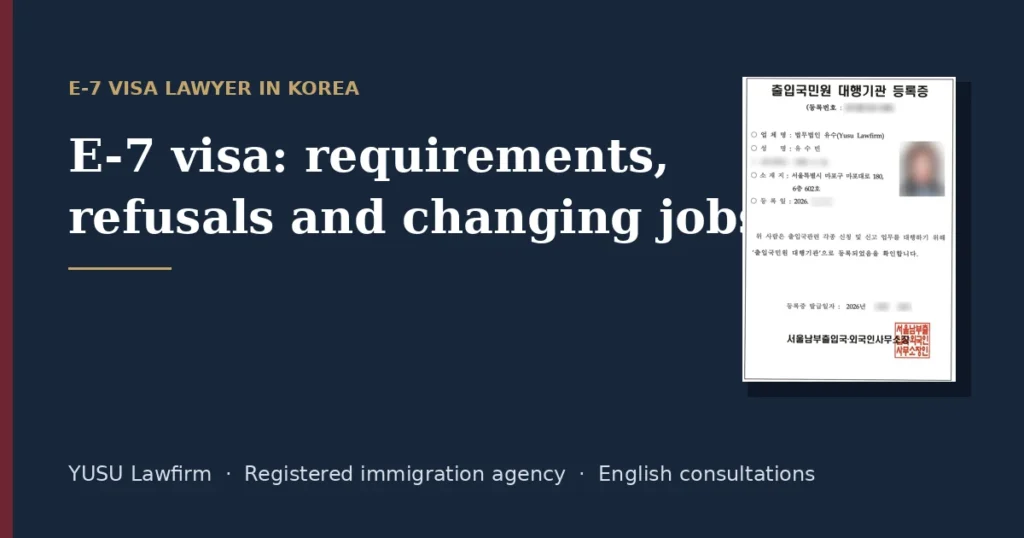
- A registered immigration agency and a law firm. YUSU Lawfirm is registered with the Seoul Southern Immigration Office as an immigration application agency. The team that files your application is the team that defends it if it is refused.
- A former prosecutor reads the criminal side. Most entry bans and departure orders start with a criminal case. Attorney Soobin You reviews what the record really says and how it can be explained.
- English without a middle layer. Attorney Soobin You and Attorney Kyungmin Kim work with you directly in English.
- Seoul, Gyeongju or Zoom. If you are already outside Korea, much of the work can be done remotely.
Frequently asked questions
Can I start working while my E-7 change is pending?
No. You need the change of status before you start the new work.
My E-7 was refused because of a small fine. Is that final?
Not necessarily. Courts have cancelled refusals where a guideline was applied without considering the circumstances.
Can I switch from E-7 to D-10 after quitting?
Only in limited situations under the guideline, such as closure of the business or the employer’s fault. Check before you resign.
How long do I have to challenge an E-7 refusal?
Normally 90 days from when you learned of the refusal. Ask also about your status while the case is pending.
This article is general information about Korean law, based on statutes and published Korean court decisions. It is not legal advice. Each case depends on its own facts, and statutory provisions are subject to amendment.
Related guides
Visa and immigration
Planning an E-7 change, or refused?
Three lines are enough to start: your nationality and visa type, what immigration decided and when, and any criminal case behind it. In reply we tell you:
- whether your job and qualifications fit the E-7 category
- which documents must be ready, and in what order to apply
- whether a refusal can be challenged, and by when
Asking us on WhatsApp is free and is not a commitment. If you need us to act, you receive the scope and fee in writing before you decide.
Consultations in English, in person in Seoul (Mapo) or Gyeongju, or by Zoom. Please do not send documents through the form.