You are in Korea because of something you did not plan: a workplace injury, an illness, a lawsuit, a refugee claim, or a family member who needs care. The G-1 visa lets you stay for it. Then an extension is refused with a single sentence, and you have weeks to leave.
Quick answer: G-1 (Miscellaneous) is a humanitarian, temporary status for people in Korea because of an industrial accident, medical treatment, a lawsuit or a refugee application, who do not fit any other visa. It is not granted or extended automatically: immigration has wide discretion. But a refusal is unlawful if it rests on a serious factual mistake or is clearly disproportionate. Courts have cancelled G-1 refusals where immigration relied on an outdated medical document and never checked the real situation.
Key points
- G-1 is a residual status under Annex 1-2 of the Enforcement Decree of the Immigration Act. Its subtypes cover industrial accidents, treatment, lawsuits and refugee claims.
- You must apply for an extension before your current period of stay ends (Article 25).
- The question is always whether the reason for staying still exists, and whether staying in Korea is really necessary for it.
- When the lawsuit or refugee process behind your G-1 ends, the basis for extension usually ends too.
- A refusal can be challenged in court, normally within 90 days of learning of it.
Who can get a G-1 visa
| Reason | Typical subtype | What immigration looks at |
|---|---|---|
| Industrial accident claim or treatment, and family | G-1-1 | Whether treatment is still needed, and whether it must happen in Korea |
| Illness or accident treatment, and a carer | G-1-2 | The real medical need, not only a diagnosis |
| A lawsuit in progress | G-1-3 | Whether the case is still pending and needs you in Korea |
| Refugee applicant | G-1-5 | Whether the refugee procedure or a court case is still ongoing |
| Foreign patient needing long term treatment, and family | G-1-10 | Length of treatment and ability to pay for it |
Subtype codes and detailed requirements come from Ministry of Justice guidelines and change over time, so check the current version for your case.
How extensions are decided
An extension is a new grant of permission to stay, so immigration has broad discretion. Courts do not decide the application again themselves. They ask whether immigration got the facts seriously wrong, ignored something it had to consider, or reached a result that is clearly out of proportion. The person challenging the refusal has to show this, which is why the evidence filed with the application matters so much.
A refusal the court cancelled
A spouse came to Korea to care for a partner badly injured in a forklift accident at work, and changed to G-1 to do so. One extension was granted. The next was refused on the ground that care was no longer needed, because a medical certificate issued three months earlier said only physiotherapy and medication were required.
The court cancelled the refusal. The injured partner had undergone bone graft surgery and the bone had not yet healed; a second operation was later needed. Immigration had relied on one older document and made no effort to check the current condition. Its decision was also inconsistent with the extension it had granted only weeks after the same certificate. The court added that telling the carer to leave and come back if care was needed again showed that immigration had not weighed the hardship at all.
Tell us your G-1 reason, the date of the refusal and what the notice says. The first question is whether the decision was based on current facts.
When refusals were upheld
- Treatment long finished. An injury had healed years earlier. The person had a preventive care decision from the workers’ compensation agency, but the appeal court held that this alone did not require an extension, since simple physiotherapy could be done in the home country. That appeal court reversed a first instance win, so the earlier win cannot be relied on.
- Only light treatment left. Where the remaining care was simple physiotherapy, a refusal was upheld.
- The lawsuit ended. When the case that justified a litigation G-1 finished, a refusal to extend was upheld.
- The refugee case ended. Refusals were upheld after a refugee lawsuit was lost, and after one was treated as withdrawn because the applicant missed two hearings.
- A late refugee claim. Someone who had studied in Korea for eight years applied for refugee status two days before the visa expired. Changing to G-1 was refused and the court agreed, noting the person could still remain while the refugee claim was reviewed through a deferral of the departure deadline.
What to file with a G-1 extension
| Your reason | Evidence that helps |
|---|---|
| Industrial accident or illness | A recent medical opinion, the actual treatment record, the treatment plan, and why it must be done in Korea |
| Caring for a family member | Evidence of the patient’s current condition and of the care you actually give, such as a hospital carer confirmation |
| Lawsuit | A certificate that the case is pending, its stage, and why your presence is needed |
| Refugee claim | Dates of decisions, appeal deadlines and proof that a case is still pending |
File the newest documents you can get, dated close to the application. A decision based on old paper is the most common weakness in refusals, and the easiest one to avoid.

When to call a G-1 visa lawyer in Korea
Before the extension application if possible, because the evidence you file then is what a court will look at later. A G-1 visa lawyer in Korea can check whether your G-1 reason still holds, gather current medical or court records and prepare the application. If you have already been refused, a G-1 visa lawyer in Korea can tell you quickly whether the refusal rests on outdated or one sided facts, file a lawsuit within the deadline and ask for a stay so you are not forced to leave in the meantime.
Your stay often connects to a separate case, such as a workplace injury claim or a lawsuit. A G-1 visa lawyer in Korea who handles both sides can make sure one does not undermine the other.


Why foreigners choose YUSU Lawfirm as their G-1 visa lawyer in Korea
- We check the facts behind the refusal. Many G-1 refusals rest on an old certificate or a closed file. We find out what immigration actually relied on.
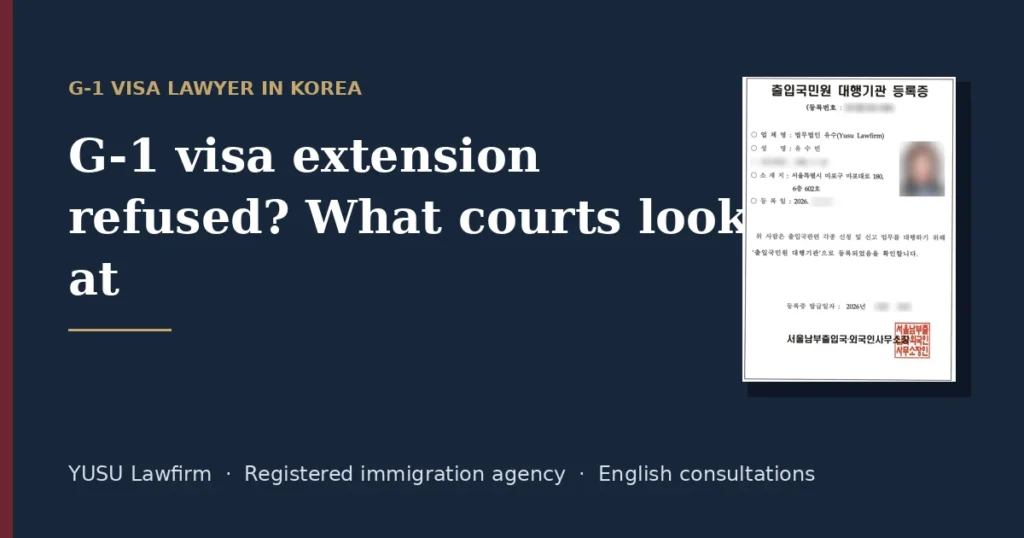
- A registered immigration agency and a law firm. YUSU Lawfirm is registered with the Seoul Southern Immigration Office as an immigration application agency. The team that files your application is the team that defends it if it is refused.
- A former prosecutor reads the criminal side. Most entry bans and departure orders start with a criminal case. Attorney Soobin You reviews what the record really says and how it can be explained.
- English without a middle layer. Attorney Soobin You and Attorney Kyungmin Kim work with you directly in English.
- Seoul, Gyeongju or Zoom. If you are already outside Korea, much of the work can be done remotely.
Frequently asked questions
Can I work on a G-1 visa?
Not as a general rule. Work needs separate permission, and unauthorised work can lead to a fine and a departure order.
How long is a G-1 extension?
It is set case by case, usually tied to the expected length of treatment or proceedings.
My lawsuit is still pending. Will my G-1 be extended?
Not automatically. Immigration asks whether you need to be in Korea for the case, and whether the case is being used only to stay.
Can I challenge a G-1 refusal?
Yes, through an administrative lawsuit, normally within 90 days of learning of the refusal. Ask also for a stay or a departure deadline extension.
This article is general information about Korean law, based on statutes and published Korean court decisions. It is not legal advice. Each case depends on its own facts, and statutory provisions are subject to amendment.
Related guides
Visa and immigration
G-1 extension coming up or refused?
Three lines are enough to start: your nationality and visa type, what immigration decided and when, and any criminal case behind it. In reply we tell you:
- whether your G-1 reason still supports an extension
- what evidence to file, and how recent it must be
- whether a refusal can be challenged, and by when
Asking us on WhatsApp is free and is not a commitment. If you need us to act, you receive the scope and fee in writing before you decide.
Consultations in English, in person in Seoul (Mapo) or Gyeongju, or by Zoom. Please do not send documents through the form.