
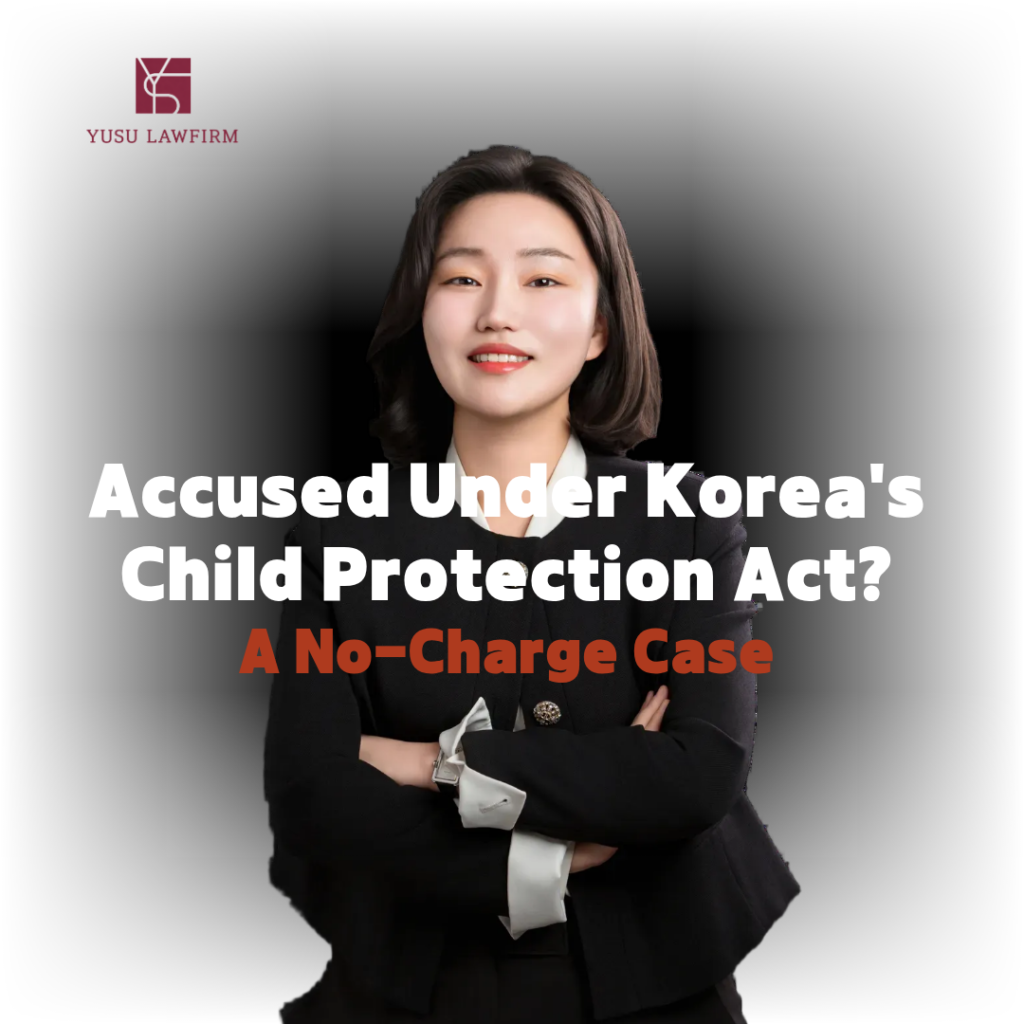
Written by Attorney Soobin You — a former prosecutor licensed in Korea, defending criminal cases with consultations available in English.
Quick answer: In Korea, an image shared between two people who both consented is not automatically “production of child sexual abuse material.” Where there is no coercion, no filming by the accused, and genuine mutual exchange, the case can end with no charges (불송치) — as one case did.
For foreigners in Korea, few accusations are more frightening than one under the Act on the Protection of Children and Youth Against Sex Offenses (아청법). Meeting someone through a social app, a mutual exchange — and then learning the other person was a minor. Here is how one such case ended without charges.

Background: a case that began on social media
The client met someone through a social app, mutual interest developed, they exchanged messages and later met. Afterward, it emerged that the other person was a minor, and the client was investigated for violating the child-protection law. These cases arise often: a brief connection where age was unclear can escalate into a criminal process. But not every such case amounts to “production” of illegal material — each requires careful legal analysis.
The core issue: whether the act was even unlawful
The central question was whether the client’s conduct was punishable “production,” or an exercise of mutual sexual self-determination arising from genuine interaction. We analyzed the relationship, the flow of the conversation, and how the meeting came about. Reviewing the chat records closely, we established with concrete evidence that the client neither filmed nor coerced anything, and that the exchange was based on mutual attraction.
Strategy: analyzing the evidence and rebutting in writing
Investigators tend to read “production” broadly — filming, storing, or transmitting. So the mere existence of an image can push a case toward charges. Through a written defense opinion and oral argument, we clearly separated who created the material, how, and for what purpose, arguing that this was voluntary conduct arising from mutual feeling, not sexual exploitation. We supported this with case law and legal commentary on how self-determination bears on unlawfulness.

The result: no charges (불송치)
Ultimately, investigators concluded there was no intent to produce exploitative material and no coercion, and that the material was made by mutual consent — issuing a no-charge (불송치) decision. While these cases often proceed to prosecution, thorough evidence analysis and legal argument reversed the expected outcome here.
Why context matters more than the statute
In these cases, the statute alone can’t resolve the question. How the relationship formed, the nuance of the conversation, the flow of emotion — these become central. That is why the client’s account and the digital evidence must be reviewed together, down to the tone of messages and expressions used.

Allegations under the Child Welfare Act reach foreign residents most often through a school, a childcare setting or a neighbour’s report, and the first contact is normally a police summons rather than a charge. How that first police interview is handled largely determines whether the file ever becomes a prosecution at all. Our English-speaking criminal defence team works on these cases from that stage onward.
Frequently Asked Questions
Q: Is a consensual image between two people always a crime in Korea?
A: Not automatically. Where a minor is involved, the law is strict, but whether conduct constitutes punishable “production” depends on coercion, who created the material, and the purpose. Context and intent are analyzed closely.
Q: What does 불송치 (no charges) mean?
A: It means the police concluded the case does not warrant referral to the prosecutor. The case ends at the police stage — no trial, no conviction, no criminal record from that case.
Q: What if I didn’t know the other person was a minor?
A: Whether, and how, that affects the case depends on the specific facts and evidence. It is a sensitive area where early, careful legal analysis is essential — do not assume the outcome either way.
Q: How are these cases defended?
A: By analyzing the relationship, the digital record, who created any material and why, and whether coercion existed — then presenting that analysis through written and oral argument grounded in law.
This article is for general information only and does not constitute legal advice. Outcomes depend on the specific facts of each case. This is a sensitive legal area — consult a licensed attorney about your situation.
Under investigation in a sensitive case in Korea? Attorney Soobin You provides English-language criminal defense from the earliest stage, with offices in Seoul (Mapo) and Gyeongju. Contact us via KakaoTalk or the inquiry form.
Accused under the child and youth protection Act?
Tell us how you met, what was exchanged, and what the police have asked you so far. You can also ask what a defence would involve and what it would cost.
Tell us about your caseCriminal defense for foreigners in Korea